

Silicon Valley has been one of the great engines of American prosperity: six of the ten largest companies in the world were founded here.1 They disproportionately drive the American stock markets; virtually every American retirement account depends on them. It is a source of tremendous global hard and soft power, a cultural icon, one of America’s great successes: when people around the world want to build technology and aspire to the future, they speak of Silicon Valley.
And yet, in its entire fifty-year history, Silicon Valley has never had political representation: no congressman, no senator, no governor has ever come out of Silicon Valley’s great technology industry. At best you might count one mayor2 and one guy on San Francisco’s eleven-person Board of Supervisors.3 This is paltry, and the lack of representation is now putting Silicon Valley at risk of being destroyed by political looters. Timing could not be worse: the global AI race is on, and bad local policy could destroy the key to America’s technological dominance and sovereignty. This places extraordinarily high, national-level stakes on keeping Silicon Valley alive.
In this essay, I will make the case that:
Financially tough times are ahead for California;
California’s government will almost certainly try to loot Silicon Valley;
Silicon Valley will flee;
This will create a severe loss for the Bay Area, for California, and for the USA;
The only way out is for successful technologists to run for and win office at every level in the 2026 mid-term elections, especially for governor;
Most importantly: if you are a successful person in Silicon Valley, I want you to think very seriously about running for office. Someone needs to step up.
1. Tough Times Ahead for California
California is going through an economic boom. Tax revenue has basically doubled over the last ten years. However, literally all of it is being spent as it comes in!
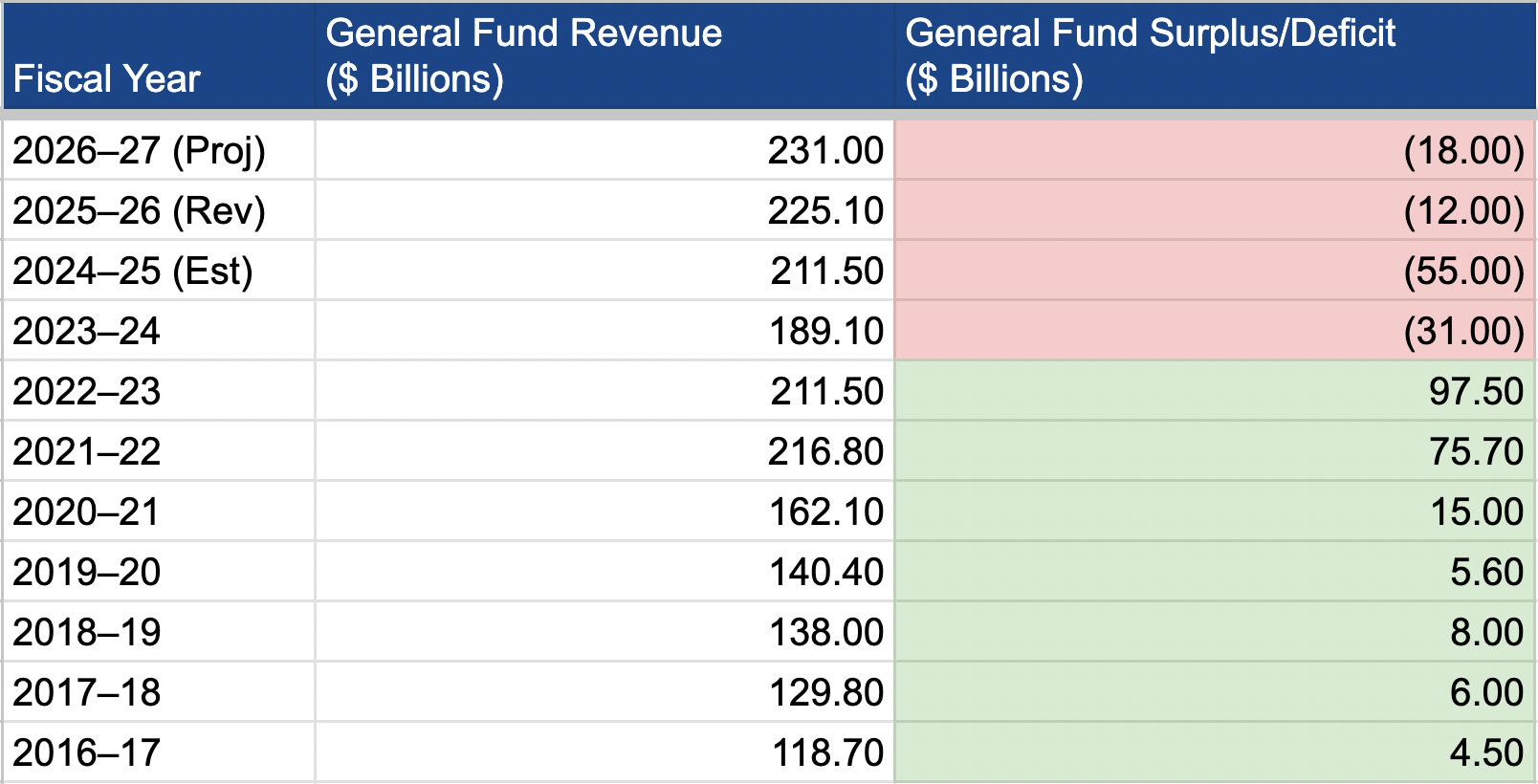
It’s a strange picture: revenues are on a generational tear — chiefly because tech is succeeding more than ever — but the state is running a deficit.
Worse, these high-level statistics actually look better than the reality, because the General Fund constitutes only about 60% of the state’s total expenditures. Conventional state budget discussions do not include all the details. For example, Governor Newsom took out a $20B loan for pandemic-era unemployment programs, which is now being slowly repaid by additional federal payroll tax. And California’s pensions are underfunded to the tune of a head-spinning $260B, for which the taxpayer is ultimately responsible.
Sometimes, when someone gets a financial windfall, it doesn’t encourage prudent saving and reinvestment, but puts them on a track of profligate, eventually-ruinous spending. This is what’s happening for the state of California. The California Legislative Analyst’s Office has projected that the state will run a $120B deficit in five years. (Simon Berens published a great interactive tool for exploring these projections.) California has the simple but hard problem of runaway spending and out-of-control entitlements.
Today, things are okay. Industry is booming, and the 2025-2026 deficit is most recently projected at only $3B. But as the business cycle naturally gyrates, severe pressure will be exerted on California’s public finances, and on the next state administration to plug the gaping hole in the budget.
2. The Looting of Silicon Valley
This essay follows a recent proposal for a wealth tax on billionaires,4 which is already misfiring spectacularly. But what stands out is that this heavy-handed, controversial tax is being proposed during a time of relative prosperity.
We must ask: if extraordinary taxes are being considered during good times, then what will bad times bring? What happens when the budget is actually under pressure?
You might hope that the state will reduce its spending, but that’s the last thing that will happen. Reducing the budget is very unpopular, because people get used to spending the budget! Nobody wants to spend less: if there were any demand for efficiency of government spend, then California’s financial catastrophes — spending $70B on high-speed rail with little to show for it, $24B on homelessness only for it to go up, or up to $31B on fraudulent unemployment claims — would’ve been righted long ago. The unfortunate reality is that the state budget is a gravy train for millions of people, and nobody has had the strength of will to contain it.
Rather than cutting spend, the state will raise taxes. Of course, it is easiest to raise those taxes from a small minority of people and institutions with lots of money: Silicon Valley is a sitting duck.
After all, how many people are actually personally interested such that they would vote against a tax on, for example, capital raised by venture funds or startups? A few thousand? Why do a one-time billionaire wealth tax when you could do it more frequently, or lower the bar to $100M or perhaps even $10M?
This might sound far out, but bear in mind: this is the same state that was radical enough5 to pass Prop 13, and because of which, it does not have property tax hikes available. By California’s own design, wealth, income, and sales taxes are easiest to reach for — which will end up being borne by the middle class, not billionaires.
3. Silicon Valley Will Flee
Like in any great tragedy, the sin itself, the attempted looting of Silicon Valley, is pointless: these are some of the smartest people in the world, who will see it coming from miles away. Many of their jobs are literally predicting the future. The public-sector unions will not outsmart them.
We saw this just over the last few weeks with the proposed wealth tax on billionaires: though the tax is to be voted on in November 2026 and implemented in 2027 if it passes, the tax obligation would be backdated to January 1, 2026 — so if the tax passes, billionaires are locked-in to paying it and can’t relocate it to escape it.
Unless, of course, the billionaires relocate in the few weeks between the ballot initiative being announced in October, and the tax threshold date of January 1. Which is exactly what happened: over a trillion dollars of wealth fled California in a few weeks, over a ballot measure which may not even pass.
The people of Silicon Valley are highly mobile. Their work can famously be done from anywhere. They’re also the most childless people in the country — conventional obstacles to moving, like nearby family or kids in school, apply much less here than elsewhere. The network effects of Silicon Valley are already weakening:
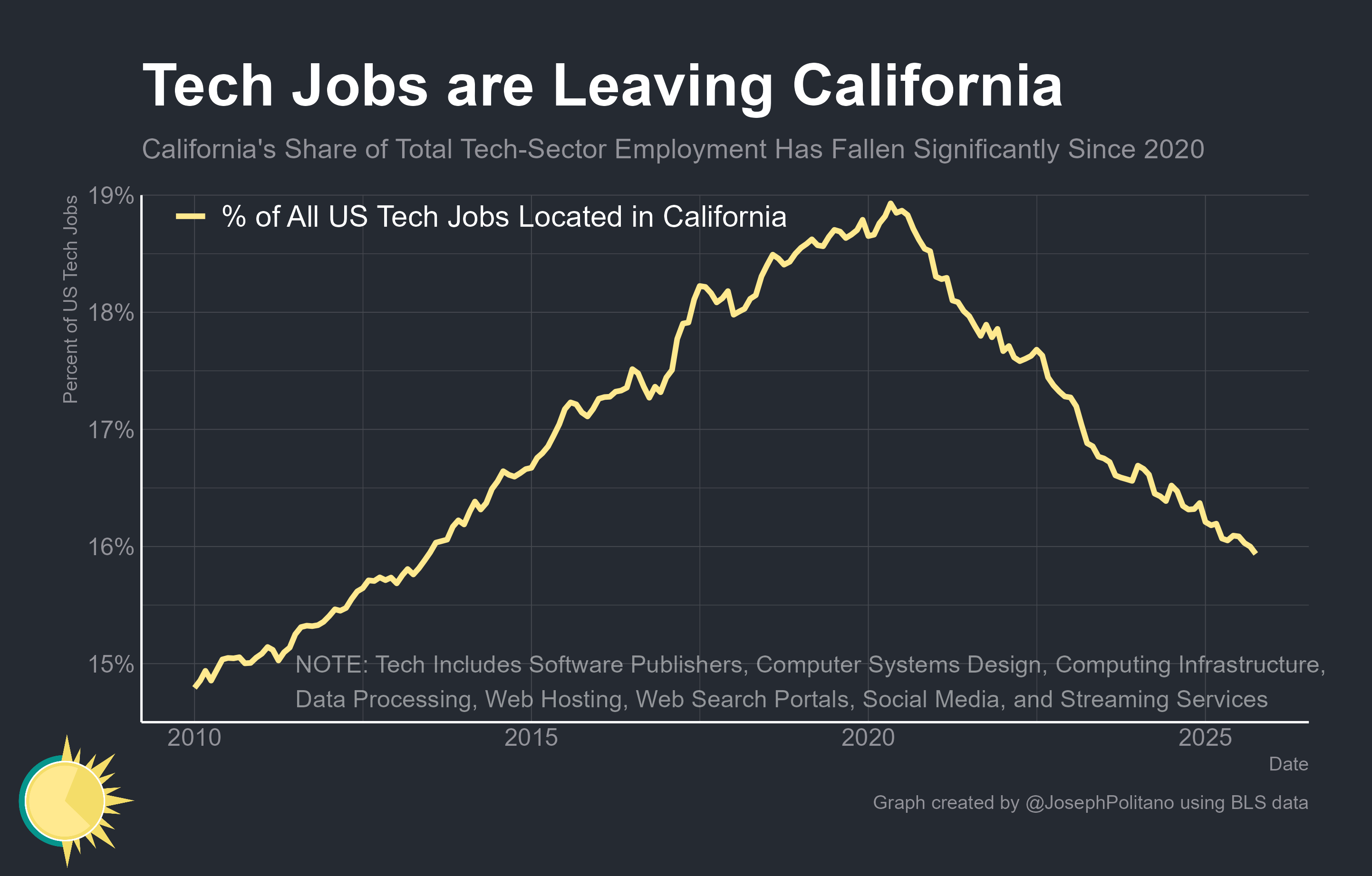
Tragically, despite harvesting great tax dollars from these people, California has failed to put those tax dollars toward building things that would keep them there: the quality of public schools is highly variable, the public infrastructure is poor, and public safety is bad. If California used its taxes to offer an exceptionally high quality of public services, then perhaps it’d have more pull. But it doesn’t. The divorce between taxes charged and public service provided has occurred a long time ago.
I have never met anyone in California who is excited for a new tax because it means a new local benefit, like a road or a sports center. The going assumption is that any new tax will be wasted in byzantine graft, no matter how noble the objective. We pay taxes like a club membership fee: the club will charge as much as it can, that’s the price of living here, and you’ll get nothing in return except admission. But the downfall of any club is that it arrogantly forgets that it is a product, and when the product gets worse and more expensive, the customers will go elsewhere — slowly, then suddenly.
It bears emphasizing that during Covid, many people thought Silicon Valley was done. Overzealous stay-at-home mandates, remote work, and an absolutely bonkers level of local crime had technologists leaving in droves. It felt apocalyptic: by June of 2021, nearly everyone I knew had left. The California exodus was real. My entire social network had dispersed to Miami, Austin, Denver, New York, Nevada, and so forth. And then I left, too.
Silicon Valley was saved just in time by AI, which reignited the local network effect. I returned, but many of my friends remained elsewhere. Though it’s boom-time in the Bay Area once more, this episode laid bare that Silicon Valley, like any product of network effects, is fragile: it is very hard to reverse the doom loop once it starts.
4. Loss for the Bay Area, California, and the USA
Potential losses to the Bay Area and California are obvious. Once executives start moving, their companies start moving, too. Google’s 80-acre San Jose megacampus is on hold indefinitely. Meanwhile, employees are moving into Google’s offices in Austin. Citadel fully relocated to Miami, after 30 years in Chicago. It can be done.
California is uniquely vulnerable because ~45% of its tax revenue stems from personal income tax, and ~35-50% of that revenue6 comes from the top 1% of earners.7 The mere proposition of the wealth tax is already going to lose a tremendous amount of tax revenue, more over the next few years than it ever would’ve gained had it passed. The new shortfall of tax revenue means that the burden will now fall on the next tranche of productive residents. The vicious cycle of trying to loot a small minority group, it fleeing, and then needing to go loot the next one, happens almost automatically, can destroy unlimited value, and capture none.
In some sense, this is a classic resource curse, where the state of California has historically had a seemingly never-ending spigot of money, totally irrespective of any actual work that the state does, and only has to spend it. This creates dependency, waste, and hollow institutions. And when it looks like the spigot will turn off, the state will go into overdrive destroying it to get every last drop out. Truly great mismanagement requires truly great resources.
Cracks show elsewhere in the armor: Hollywood is no more. And the homes in the Pacific Palisades that burned down a year ago still haven’t been rebuilt. The lack of California’s state capacity is clear. It now has the most expensive electricity in the continental United States, which reminds of de-industrializing countries like Germany and the UK, currently undergoing economic doom loops themselves. Californians would be wise to look to those countries, for which the last 25 years hold just one lesson: it is possible to fall from prosperity.
California would not be the first state to lose its fortune. Boston, once a hotbed of American entrepreneurship, managed to kill its startup ecosystem. Many countries in Europe have experimented with wealth taxes and seen their most productive citizens leave. Too-clever-by-half countries like Norway slapped on exit taxes on top, only to thereby choke off local entrepreneurship altogether. It is a bitter irony that nearly every great technology with European founders is started in America. California may be beautiful, but so is Europe. People move on.
But the story does not end here. The stakes are greater: we are living through the AI revolution. America must develop leading AI capabilities to keep our technological position, and — if AI truly does diffuse everywhere — to keep our sovereignty. We are in the midst of an AI race, and we would be well-advised to stay ahead! To that end, we have the greatest possible advantage: pretty much the plurality of the world’s greatest AI researchers and engineers all living in the same place, knowing each other, exchanging information in their tight-knit community. We have an organic, private-sector Manhattan Project. We have firms raising tens of billions of dollars to invest in the smartest entrepreneurs building AI in America. This is a priceless national asset, far beyond the capabilities of any other nation-state but China. Squandering this advantage — and that includes the dispersion of Silicon Valley residents, crushing the productive in-person network effect — because of the short-sightedness its own political representatives would be an unspeakable historical loss.
5. Successful Technologists Must Run for Office
The stakes are great. We as technologists need representation because we will otherwise be governed by unwise forces, which may spell our destruction.
The greatest of penalties is being ruled by a worse man if one is not willing to rule oneself.
Plato
Silicon Valley figures have historically avoided politics, for a variety of reasons: they have great companies to run, the financial payoff from entering politics tends to be poor, and the quality of life tends to be worse, with all kinds of people mad at you all the time. They have instead stuck to donating and delegated the thick-skinned job to representatives like Ro Khanna, who have unfortunately shown that they cannot be trusted to represent these constituents: as so often in financialization, we cannot pay someone else to do the job, but we must do it ourselves. Someone needs to step up.
It is an unthinkable sin that the work of the greatest innovators and savviest capital allocators of our time is given as tribute, placed on the high altar of government, only to be frittered away on waste and fraud. Only when the waste and fraud is cataclysmically bad has the tech community stepped up to respond. But being reactive is, of course, a poor way to participate. We need tech to be proactively and affirmatively involved in governance — imagine how prosperous our ecosystem would be if we worked to support it, rather than having it administered by fools who see it as a cumbersome cash-cow to be milked. In a wiser land, the government would throw everything it has at supporting Silicon Valley and making sure that the technology sector keeps compounding.
If you feel any love for where you live, at any level — whether for San Francisco, California, or the United States — and you’re successful enough to command the respect of the public, then you should run for office.8 We need representation. I will do whatever is in my power to support you. I love California and want it to succeed. Reach out to me and I will put you in touch with like-minded people.
As a parting thought, while I have focused on state and local issues in this essay, I’d like to highlight that perhaps even greater trials lie ahead: as AI begins affecting labor markets and changing our society more broadly, it is easy to foresee some public uncertainty and “reining in AI” becoming a hot-button political issue at the federal level, and characters like Newsom or Khanna turning on Silicon Valley to advance their own national-political ambitions. Neutering Silicon Valley would, of course, leave the US losing the AI race to China. We need courageous technologists to step up and guard the goose that lays the golden eggs.
As counted by public market cap: Nvidia, Apple, Google, Meta, Broadcom, and Tesla. I’m leaving out private companies and fun gotchas like Saudi Aramco technically having been founded in SF.
Matt Mahan of San Jose spent a few years building civic engagement technology products.
Bilal Mahmood was a tech founder before joining the SF BoS.
This blog post is about much more than just the wealth tax, so I’m not going to spend any time addressing it. My position on it is basically the same as David Friedberg’s: it is an unprecedented seizure of private property, and a trojan horse that will eventually seize the assets of the middle class. Once you take this genie out of the bottle, you’re not putting it back in. The mandate of the tax will only expand over time — taking from the economically productive classes to give to the political classes.
As an aside, California has something of a historical record of passing unwise tax policy. San Francisco passed a gross receipts tax (Prop C) that caused Stripe to flee, losing one of its largest, most talent-dense employers, and of course not capturing the intended revenue. In 1978, California passed Prop 13, now one of the great culprits of the housing crisis.
This depends on the tax year; it’s quite variable depending on e.g. liquidity events.
This social contract was enormously generous to the state of California: all these mega-billionaires paid colossal income taxes, year after year, really just because they liked it there. It turned out that it was so easy to move, all this time. The wealth tax consideration was an unforced error of amazing magnitude.
If I’m going to write a whole essay about why you should run for office, I should address: why don’t I run for office? There are a few reasons, but most importantly, I only recently moved back to California after not having been a resident for a few years, which would hamper my credibility.
I am running in Nevada. Answered you on X, and I hope you don't mind me answering here. If you do, feel free to delete my comment. I won't be offended.
I have seen cynical comments about politicians, and frankly, I agree with them. I am cynical and criticize them from my armchair. I have never been one, nor want to be a career politician. But, @JohnLoeber is right, people like us have to run. They will rob us blind if we don't.
I picked the State Treasurer's race for a lot of reasons, but the biggest one is that it fits my background. Others might pick different races, and I encourage them to think about local school boards all the way up to a state race. Even getting involved with your local political party to vet candidates so you get competent ones can help. I'd suggest that you use this app before you decide: app.candidatepathways.com. It is very helpful. Don't know if that link will work, but maybe candidatepathways.com will.
There is a lot to understand about running. This is not like a startup because there are election rules and laws. You don't want to wind up in jail for fundraising or reporting improperly. I blogged about it at my Substack, and will continue to blog about it, but one of my first hires was incompliance.net.
We tend to think about the campaign and forget about the plumbing. You have to create a good backoffice before you can do anything. Once you get into it, you realize it is a multibillion dollar business and there are plenty of ways to build things that might make it easier for people to run. However, state election laws are diverse, so what works in California might not work in another state. Local county rules might layer on something else, depending on state rules.
Everyone hates the "money in politics," but the fact is, you can't run without raising money. Even if you put your own money in the race, which I am doing, you need to raise. Otherwise a lot of voters think you are just trying to buy an office; even when your intentions are good.
Both my opponent in the primary and potential opponent in the general have no financial experience in their life, and want to be career politicians.
Downballot races in states are becoming more and more important. The fraud in Minnesota is just one example where a down-ballot executive could have stopped or at least blown the whistle on the fraud. Because a lot of people see politics as a career, they will run a down-ballot race in hopes of pursuing a higher office, like Governor, where they can do major damage to an economy. In my state, socialists are putting money into local judge races so they can control the judiciary.
Here are some reasons to support me if you aren’t from Nevada:
· Your hard-earned tax dollars are being shipped to Washington DC and back to state governments, only to vanish into waste and outright fraud. Putting someone you know and trust—someone with a proven track record—in control of the purse strings is the single most effective way to slam the door on corruption and ensure every dollar is spent responsibly.
· With the financial expertise and innovative mindset that people like us bring to the table, Nevada is the perfect proving ground. A smaller state lets us implement bold, cutting-edge reforms quickly and demonstrate undeniable results. When Nevada succeeds, other states will follow—and we’ll lead a nationwide financial revolution.
· The path from private citizen to public servant feels impossibly steep—especially for those of us who’ve never been career politicians. That’s exactly why we desperately need people like us to step up and run. Backing me now and watching me win will shatter that barrier, inspire a wave of principled, non-career citizens to run, and finally begin draining the swamp of entrenched, self-serving politicians.
· For the first time, the tech, trading, and finance community has a real champion running for office—someone who actually understands our world, speaks our language, and will fight for our interests.
https://secure.winred.com/jeffrey-carter-for-nevada-531b0a14/donate-today
Saving the golden goose from the stew pot may require more than a couple candidates. We are in a deeply populist political era. We've got two generations who are so economically illiterate that many of them truly think this is a zero sum game whereby tech billionaires get wealthy by stealing/hoarding money instead of by creating goods and services people want and willingly pay for. This is why the DSA and all the failed policies they champion have made such a come back in political discourse in the last couple years.
There's a propaganda war being waged and capitalists are the losing side.